A section-by-section guide to documenting ADHD assessments, with a worked example note and how AI scribing speeds it up.
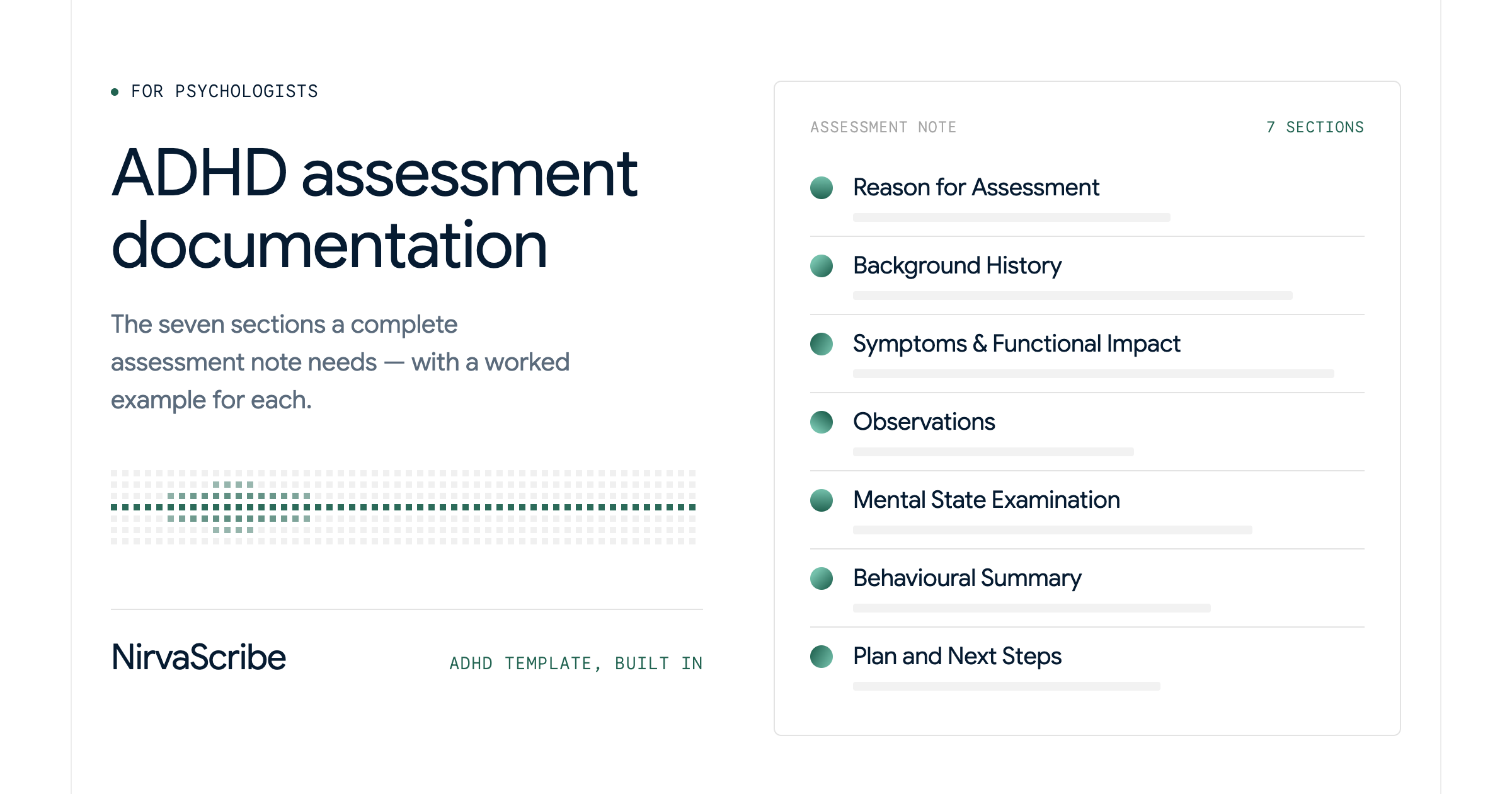
Documenting an ADHD assessment properly matters for diagnosis, for treatment planning, and for anyone else who reads the file later. But it's also one of the more time-consuming notes to write, with a lot of specific information to capture accurately.
Here's what a solid ADHD assessment note should include, and how to make the process faster.
An ADHD assessment note is the clinical documentation created during (or after) a session evaluating a patient for ADHD. It captures the information needed to support a diagnosis — background history, observed and reported symptoms, mental state findings, and a clinical impression in a structured format that's useful for treatment planning and for anyone else who reads the file later.
Reason for Assessment Who initiated the referral and why — the presenting concerns that led to the request for an ADHD assessment.
Background History Pregnancy and birth history, developmental milestones, family structure and dynamics, family history of ADHD or other psychiatric conditions, and relevant schooling information.
Symptoms and Functional Impact The presence, frequency, and context of ADHD-related symptoms like inattention, hyperactivity, impulsivity, and how they affect functioning across social, academic, occupational, and home settings.
Observations What you observed during the session itself: attention, activity level, impulse control, ability to follow directions, and social interaction.
Mental State Examination (MSE) Behaviour, mood, affect, thought content and process, and cognitive functioning (attention, memory, concentration) observed during the clinical interview.
Behavioural Summary A synthesis of behavioural patterns across settings, consistency of reported symptoms, and any relevant psychological or developmental considerations.
Plan and Next Steps Proposed next steps further assessments, referrals, feedback sessions, psychoeducation, or recommendations for school or workplace accommodations.
Reason for Assessment
Background History
Symptoms and Functional Impact
Observations
Mental State Examination (MSE)
Behavioural Summary
Plan and Next Steps
ADHD assessments are detailed by nature. You're pulling together self-report, observation, collateral information, and standardised measures into one coherent note — often across a session that ran long because the conversation genuinely needed the time.
NirvaScribe listens during the session and drafts your notes as you go, organised into structured sections so the information above gets captured accurately without you typing it all out afterwards.
We also have a dedicated ADHD assessment template built in, structured around these exact sections ready to use as-is or customise to how you document.
Does an ADHD assessment note need to include rating scale results?
Yes, it's good practice to note any standardised measures you use alongside your clinical observations. For adults, CAARS is a widely used tool in comprehensive psychologist-led assessments, often alongside the ASRS, which GPs also use as an initial screening step before referral. For children, different age-appropriate scales apply.
How long should an ADHD assessment note be?
Long enough to support your clinical reasoning there's no fixed word count. A thorough note across the sections above typically runs to one or two pages, covering background, symptoms, observations, and your plan.
Can this structure be used for both adult and child ADHD assessments?
Yes, the same core sections apply, though what you document within each will differ. For children, background history will lean more on developmental milestones and school reports; for adults, functional impact often centres on work and relationships.
If you're currently writing these notes from scratch each time, it's worth trying — start your free trial and see how much time it saves on your next assessment.
Sixty sessions a month, free forever. Two minutes to set up. No card.
