What to include in a discharge summary, common mistakes, and a practical worked example.
There's a particular kind of tired that shows up at the end of a shift, right when the discharge summary still needs writing. It's usually the last thing standing between a nurse and going home which is exactly the wrong moment to be assembling the one document a patient's entire post-hospital care depends on.
A discharge summary is the handover document written when a patient leaves hospital. It records why they were admitted, what was done, and what needs to happen next. The discharging nurse or doctor usually completes it, using notes from the whole care team.
Several people rely on it. The GP uses it to continue care. Community and district nurses use it to plan home visits and wound care. Allied health teams physio, OT, pharmacy use it to continue treatment without starting from scratch. And the patient or their carer often keeps a copy to know what happened and what to watch for.
A South Australian review of over 7,000 discharge summaries found more than a third were sent out late. Each extra day of delay raised the odds of readmission within 30 days.
This isn't about carelessness. It's what happens when a demanding document gets written from memory, at the end of a shift, by someone already out the door.
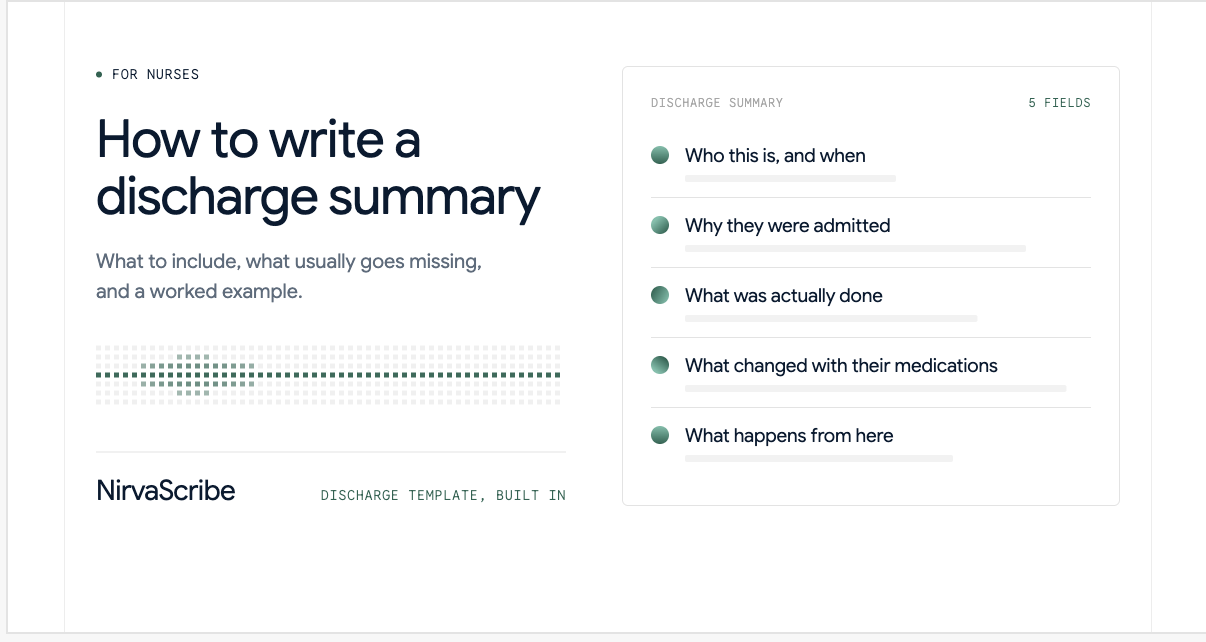
Strip away house style and every discharge summary is answering the same handful of questions for a clinician who wasn't in the room the questions nurses are, in practice, most often the ones answering:
This maps closely onto NSQHS Standard 6, Communicating for Safety, which requires every Australian health service to define a minimum information standard for handover and discharge, and the ACSQHC's national guidelines for electronic discharge summaries. It's also just what the NMBA Registered Nurse Standards for Practice ask for more generally: documentation accurate and complete enough that someone else could safely pick up care from it cold.
Name of the Patient: John
Date of Admission: 3 February 2026
Date of Discharge: 9 February 2026
Reason for Admission: 74-year-old woman presented via ED after a mechanical fall at home, with left hip pain and inability to weight-bear. X-ray confirmed a displaced intracapsular fracture of the left neck of femur. Background of osteoporosis and well-controlled hypertension.
Procedures Performed:
Medications Prescribed:
Follow-up Care Instructions:
Nothing in that example needs a phone call to clarify. That's the actual test of whether a discharge summary did its job.
Five short lines, and there's nothing in there the next clinician has to guess at.
Two other gaps come up again and again.
Pending results - Anything still outstanding at discharge, pathology especially needs to be named, with someone clearly responsible for following it up. Left unflagged, it's easy for a result to fall through the gap between hospital and community care.
Vague follow-up - "GP follow-up recommended" isn't really an instruction. The ISBAR structure, used across Australian clinical handover, exists to stop people writing sentences like that and calling it done, follow-up needs a who, a what, and a when.
Medication Changes - Medications are the section most likely to make or break a discharge summary. The usual problems: a dose change with no explanation, a medication that quietly disappears between admission and discharge, a switch with no reason given. This is also the section a GP or community nurse actually acts on — so a gap here matters more than a gap almost anywhere else.
The fix is simple: say what changed and why, not just what the patient's going home with. "Ceased regular paracetamol, pain resolved; started enoxaparin 40mg daily for VTE prophylaxis" tells the next person what happened. A plain list of current medications doesn't.
A discharge summary is only as good as the notes it's built from dictating or writing by hand, the same habits help:
The common thread: the discharge summary isn't really written at the end of the shift, it's written throughout it. Good notes along the way are what make the last document fast instead of painful.
NirvaScribe comes with a discharge summary template built in ready to use straight away, no setup required. It drafts the summary from your shift and consultation notes, filling in the fields above: reason for admission, procedures, medications, follow-up.
Every ward documents a little differently. Start from NirvaScribe's built-in discharge summary template and customise itto match what your unit actually needs — add the fields covered in this guide, adjust the detail, drop what doesn't apply.
The same privacy obligations apply to a discharge summary drafted with AI assistance as to any other clinical documentation. The Australian Privacy Principles govern how the underlying patient data is handled, and patients should know a digital scribe is in use before or during the consultation in line with the TGA's guidance on digital scribes and the NMBA's codes and guidelines for nurses.
https://www.nirvascribe.com — free 60 sessions a month, no card required.
Sixty sessions a month, free forever. Two minutes to set up. No card.
